The beginning of 2023 found us exploring and enjoying life, family and friends in Valencia, Spain.
It has been a couple of years since we have written about Valencia and we wanted to capture our more recent pictures and share our experiences. Art galleries are worth revisiting, especially to see the temporary exhibitions and to discover new artists. Of course the annual Las Fallas Festival held in March, with its dramatic 30 – 60 feet tall (9-19 m) monuments that are constructed and then set afire each year, is a perpetual favorite of ours.
Fundación Bancaja
We have posted 25 blogs about Valencia over the past 5 1⁄2 years and yet somehow we missed sharing the Fundación Bancaja, a vibrant cultural and exhibition center located in the heart of the city. It hosts exhibitions by local and national artists, as well as international exhibitions from contemporary art to historical displays and we always discover something new.
The popular permanent exhibition is the “Bancaja Collection”, which features art from the 20th century, including works by famous Spanish artists like Salvador Dalí, Joan Miró and Pablo Picasso, as well as international artists like Andy Warhol and Roy Lichtenstein that should not be missed. However it was the temporary exhibitions that captivated us on this visit.
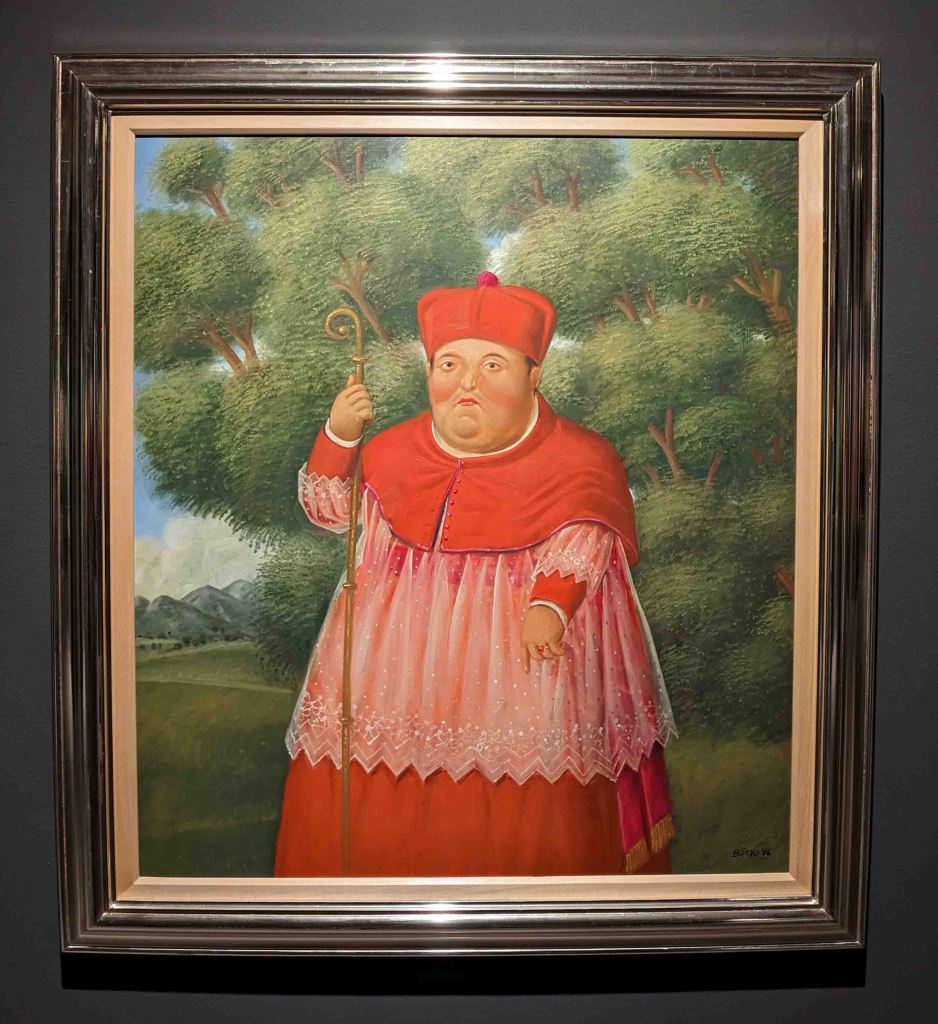
Fernando Botero is a Columbian artist (1932-) who paints whimsical people and figures in “large and exaggerated volume” and his style is now known as “Boterismo”. His charismatic figures and figurines were somehow very appealing to us.
Another interesting exhibition, although somewhat darker, was by the Spanish artist, Juan Genovés Candel (1930-2020), whose work was strongly influenced by the historical events he lived through, especially the Spanish Civil War and Franco’s oppression of the spanish citizens. There are photos of his work in the Fundación Bancaja link at the bottom of this blog.
CCCC, Valencia
The CCCC (Centro del Carmen de Cultura Contemporánea) is located in the neighborhood of our first apartment in Valencia and we have fond memories of both the neighborhood and this gallery.
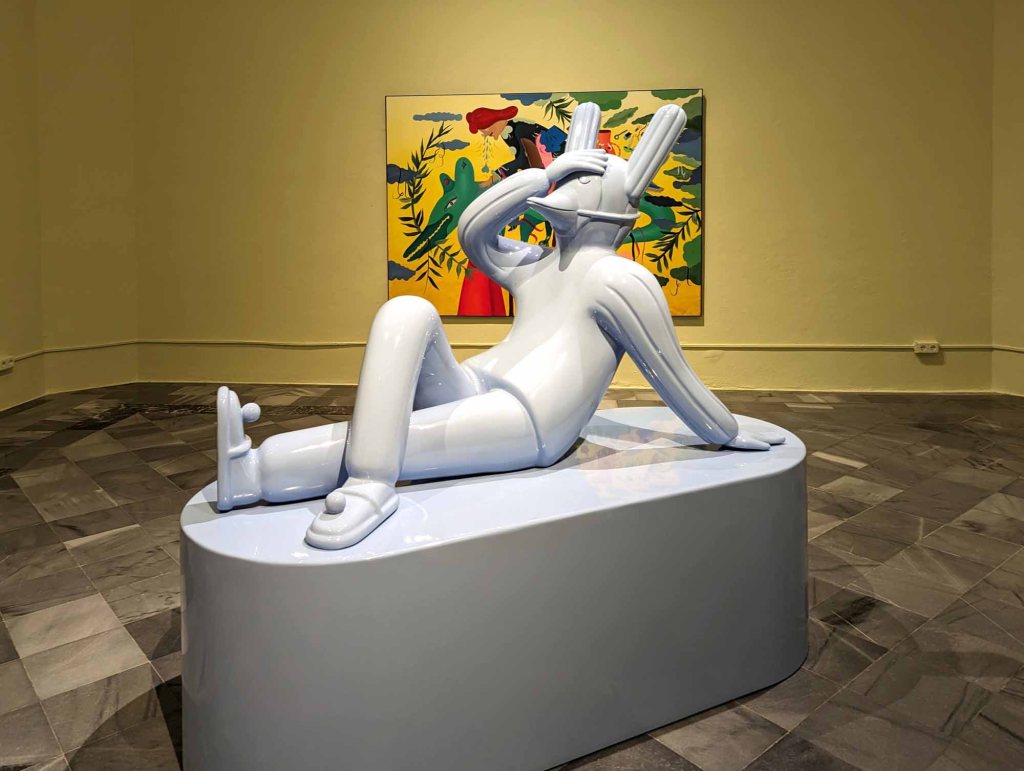
One of our favorite temporary exhibitions on this trip, was called ‘Infinity’, was by the Spanish multidisciplinary artist and designer, Jaime Hayón (1974-). His paintings, designs and sculptures have been described as “hard to define and easy to love” and “a joyous visual delight”. Admittedly much of his work did make us smile. We were also drawn to this charming set of 3 vases, below, the artist created.

IVAM
The Institut Valencià d’Art Modern (IVAM) is one of our favorite and most often visited modern art galleries in the city. One exhibition we enjoyed, entitled ‘Pinazo is Public Paces’ was by Ignacio Pinazo Camarlench (1849-1916) a 19th century Spanish impressionist painter from Valencia. Photos linked at the bottom of the blog.
Another exhibition “Paths to Modernity in Les Falles” by local artist Alfredo Ruiz Ferrer (1944-) piqued our interest because of the Las Fallas connection. Ruiz began training in the trade of the Fallas workshops when he was 13 years old and for decades he created pieces for Falles, winning first prize in the Special Section in 1974, 2008 and 2013. The exhibition focuses on his decorative pieces and we felt the piece below, entitled ‘Encounter with art’, 1990 was intriguing. If you look closely you may see art by Miro, Mondrian, Gris and Kandinsky included in the composition.

Museum of Fine Arts of Valencia
There are a number of excellent contemporary and modern art museums in Valencia we enjoy, but we prefer fine art museums and we think the Museum of Fine Arts is the best the city has to offer. Their permanent collection includes outstanding religious art and an entire section full of pieces by Francisco José de Goya y Lucientes, the Spanish romantic painter and printmaker more commonly known as Goya (1746-1828). However it was the exhibition called “Lladro Collection: From Darkness to Light” that drew us back to the museum this year.
It has been one century since the Valencian born artist, Joaquín Sorolla Bastida (1863-1923) died and this year Valencia is celebrating and honoring the ‘Painter of Mediterranean Light’s’ life and oeuvre. He created appealing paintings that earned him recognition throughout the world. We have visited the fabulous Museo Carmen Thyssen in Málaga as well as the wonderful Museum Sorolla in Madrid. The museum in Madrid is actually Sorolla’s former family home and the walls are covered with his creations. Unlike his contemporaries, Joaquín Sorolla created joyful, bright and optimistic paintings and his sublime Valencian beach and water scenes are our favorites.
Recently acquired by the Museum of Fine Arts are 75 paintings that belonged to the Lladró family. The paintings were found stored in boxes in a warehouse in Madrid. Dubbed “From Darkness to Light” the collection has not been seen in years. Joaquín Sorolla is the star in the exhibition but there are other remarkable paintings we also admired by Juan de Juanes, José de Ribera, Francisco Zurbarán, José Benlliure and Ignacio Pinazo.

Las Fallas Festival

We cannot talk about springtime in Valencia without sharing the Las Fallas Festival – the dresses, the jewelry and hairpieces, the costumes, the parades, the bands, chocolate & churro and buñelos stands, petardos or small fireworks, mascletas or medium fireworks lit midday for the percussion or rhythm of the blasts, and the more usual large brilliant nighttime fireworks displays. There are not-to-be-missed beautifully designed lighting and light shows over top of the streets and the flowers, the Ofrenda – where thousands of costumed participants parade through the Valencian streets for 2 full days walking their bouquets of flowers, thier offerings, to the Plaza de la Virgen where a massive Virgin Mary is then created using the bouquets as building materials.

There are more than 700 fallas or monuments that for 5-7 days prior to the start of the Las Fallas week, are constructed in street intersections and then burned (la cremà) at the end of the festival, about 10 days later. These are the essence of the entire festival and are a “must-see-once-in-your-lifetime”. During festival week, offices are closed, streets are shut down, the streets get messy, the city is chaotic and everyone is out exploring the city on foot. It is truly an amazing time to experience Valencia. Within a couple of days following the end of the festival, the streets are reopened, the city is cleaned up and life resumes, much more calmly.
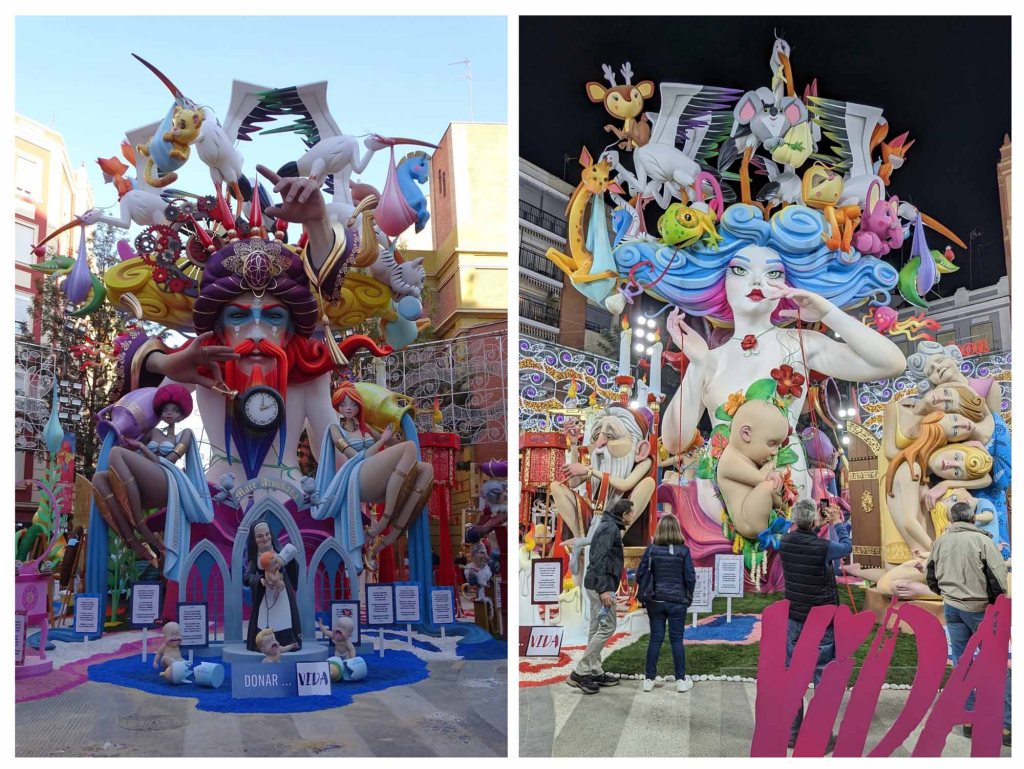
Niñot Exhibition
Each year every group that builds a falla on the street submits at least one piece, called a niñot, into an exhibition that is open to the public. The public buys a ticket and slowly winds their way through the exhibition viewing hundreds of niñots. Before leaving the exhibition you are asked to vote for your favorite niñots, one from the childrens submissions and one from the adults. The exhibition closes on March 14th, the day before the festival begins, the niñots are returned to their fallas out on the street, the votes are tallied and one winning adult and one winning children’s niñot are announced. The winners are ‘saved from the fires’ and entered into the Museu Faller de València (open all year). All other niñots will be burned in ‘la crema’ on March 19th, the final night of the festival.

Our header photo at the top of the blog was taken at dusk and is the Ciudad de las Artes y las Ciencias, (The City of Arts and Sciences) a breathtaking architectural complex in Valencia that we visit every chance we get. Designed by the amazing Spanish architect, structural engineer, sculptor and painter, Santiago Calatrava Valls, The City of Arts and Sciences is an important tourist destination and one of the 12 Treasures of Spain.
The complex is made up of the following buildings and structures.
1) L’Hemisfèric – an IMAX Cinema, planetarium and laserium.
2) Museu de les Ciències Príncipe Felipe – an interactive science museum that resembles a whale skeleton. The building has 3 floors used for exhibitions although much of the ground floor is taken up by a basketball court.
3) L’Umbracle – an open structure with a landscaped walkway, garden with indigenous plants and an outdoor art gallery with sculptures by contemporary artists. When we last visited, the noisy wild green parrots were building nests that resembled apartment buildings.
4) L’Oceanogràfic – the largest open-air oceanographic aquarium in Europe and home to more than 500 different species. It was built in the shape of a water lily by the architect Félix Candela.
5) Palau de les Arts Reina Sofía – an opera house, performing arts center and auditorium.
6) Montolivet Bridge – concrete road bridge crossing the dry Turia riverbed and connecting the structures.
7) Assut de l’Or Bridge – a white cable-stayed bridge at 400+ feet high(125 m), is the highest point in the city and resembles the top of a whales tail.
8) L’Àgora – a covered plaza where concerts, performances, exhibitions, conventions, staging of congresses and sporting events are held.
Living is easy in the temperate climate during the late winter and early spring in Valencia. There is always something happening and this vibrant city offers plenty to do, see and experience.
Salud from these Valenciano’s,
Ted + Julia
View our Bancaixa Foundation (2023) photo album here
View our CCCC, Valencia (2023) photo album here
View our IVAM (2023) photo album here
View our Las Fallas (2023) photo album here
View our Museum of Fine Arts of Valencia (2023) photo album here

 Our Tapestry
Just came to see what you’re up to and inform the gang. Happy birthday, too! You’re one day before David Anderson. 🙂 Glad you guys are doing awesome in Spain. From your really old buddy Steve Tunstall
LikeLike